Friday Inspiration: Alberto Placido

inscape01

While Alberto Placido’s commercial work focuses largely on architecture it’s his personal work that explores the natural world that I find most appealing.

The image above is the first image in the Inscape series. I have particularly enjoyed look at the work that deals with the coast (perhaps not too surprisingly), the very dark images of the ‘Invisible Landscape’ with highlights of white from the sky or breaking waves reminded me of my own pre-dawn visits to the coast, while those of ‘Between Sea and Sky’, such as the one below, give the sense of standing on the deck of a boat looking out at the ocean.

mar_e_ceu_011

Alberto’s video below is interesting and I’d love to see the still images that came from this trip.

Mist from Alberto Placido on Vimeo.

You Keep Shooting

Nixon_130517_5940-Edit-Edit

If you’ve ever watched any of Brian Peterson’s short photography instruction videos then you’ll recognize the tag line in the title of this post.

What actually went through my mind as I was reviewing photos from this evening shoot at Rialto Beach was ‘I should have kept shooting’. In my defense the circumstances were challenging. The tide was doing odd things. It would recede and seem like it was going out, but then the next wave would come 2 or 3 feet higher up the beach than it had for the last five minutes. I was getting caught out by this every time and I was getting wet. So what I had was a set of images where the log rolled and was blurred, the tripod moved as it sank in the sand and on and on. It wasn’t until I got to the last image in the set that I had the one at the top of the page. In hind sight I should have stuck with it at least a little while longer. I could have taken my shoes off and rolled up my pants, or just embraced getting wet and dealt with it. Whatever I did I should have kept going.

A lesson for next time – commit to getting the image and stay with it.

Friday Inspiration: Peter Schlör

schloer-reventon_2011

Any guesses where this photograph by German photographer Peter Schlör was taken? Any of my British friends recognize a popular summer holiday destination?

I recently came across Peter Schlör’s book ‘Black and Wide‘, a collection of very moody black and white photographs that if you’d told me were of the Pacific Northwest I would have believed you. But no, they were taken on the Canary Islands. I couldn’t believe it. When I think of the Canary Islands I think of it as a summer destination, the ocean, blue skies & bright colors. What you’ll find in these pages are images with very dark shadows, trees, fog and low clouds. It’s an amazing transformation. I’m looking forward to finding out more about Peter’s work.

I was pleased to find the video below of Peter and the team getting ready for an exhibit of the Black and Wide images but very disappointed to find out that it was all in German. Anyone able to help out with a translation?

In any case, it was interesting to see how the images were prepared for exhibition. This is one of the things that you miss out on when looking at images in a book, the scale of the final prints. It was interesting to see what an eclectic mix of sizes and presentation styles that were used and it makes me wonder why he made the choices he made. Worth a look even if you don’t speak German!

Focus Stacking to Extend Depth of Field

Nixon_130516_4876-2
I thought that focus and depth of field were pretty simple. For things where you want to blur the background, focus on the subject, use a low F number (f4 or lower) and you’re good. For flat planes or things that are far away, focus on the subject and use a mid F number (f8 ish). For the grand landscape shot where you want front to back in focus, focus a third of the way into the scene and use a high F number (f22 or above).

This is probably as much as you really need to know to make very good photographs. However, like many things that seem to be simple, if you want to pick away at this and go deeper you can.

In the case of depth of field the only thing that is in focus in your photograph is that which you focused on and everything else on that plane. The rest of the stuff in your photograph that you think is in focus is actually ‘acceptably’ out of focus. For medium and large format cameras, cameras that have ‘movements’, that allow you to tilt the plane of focus this means that you really can get front to back focus, this is an application of the Scheimpflug principle. Those of us using DLSRs are out of luck unless we have a tilt shift lens that will allow you to do the same thing.

So, how to get front to back focus? Easy, take multiple images with different focus points and then blend them together in Photoshop to get what you want to be in focus, in focus. For this kind of shot rather than set the lens to f22, I would recommend that the f stop you choose be the one at which the lens you’re using is optically the best. As a rule of thumb this is usually 2 stops away from wide open, so for an f4 lens this would be f8.

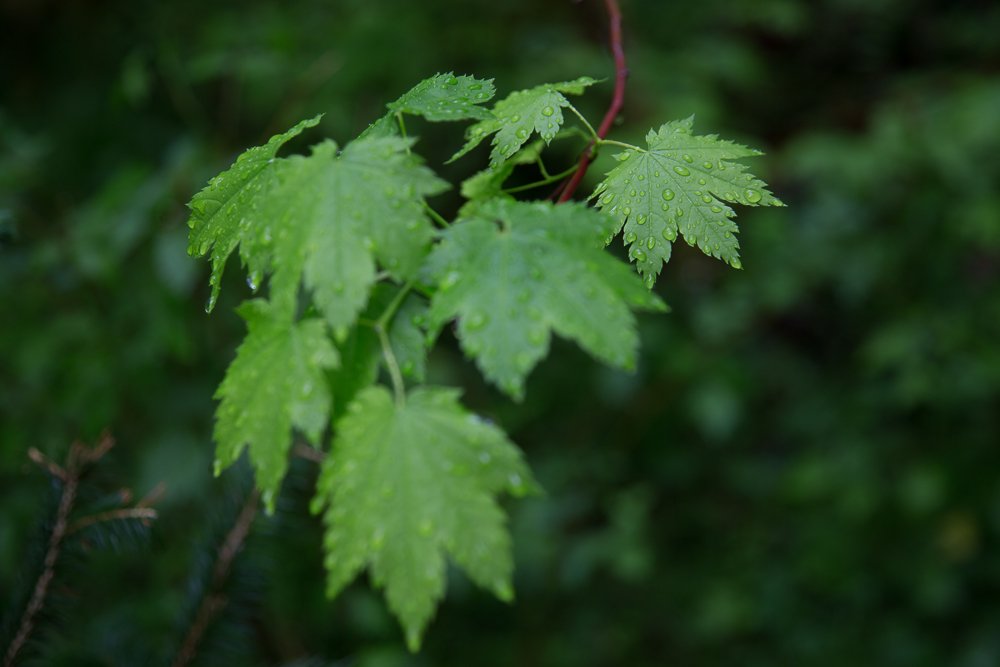
So you’ve taken your shots – in this example I was exploring rain drops on some maple leaves. The images were shot at f4 to blur the background. In one image I focused on the front set of leaves and in the second I focused on the back leaves. Click on the images to see them larger.

Nixon_130516_4875 Nixon_130516_4876

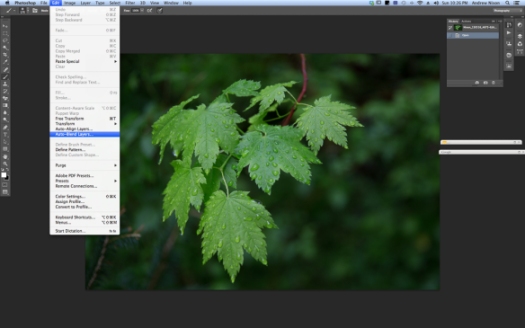
The first thing to do is to open the images in photoshop and load them into separate layers. Once you’ve done that you can then go to the edit menu and select auto-blend layers:
Nixon_130610_

then stack images in the dialog box that appears next.

Nixon_130610_-2

This gives the blended image with good depth of field from the front to back leaves.

Nixon_130516_4875-Edit

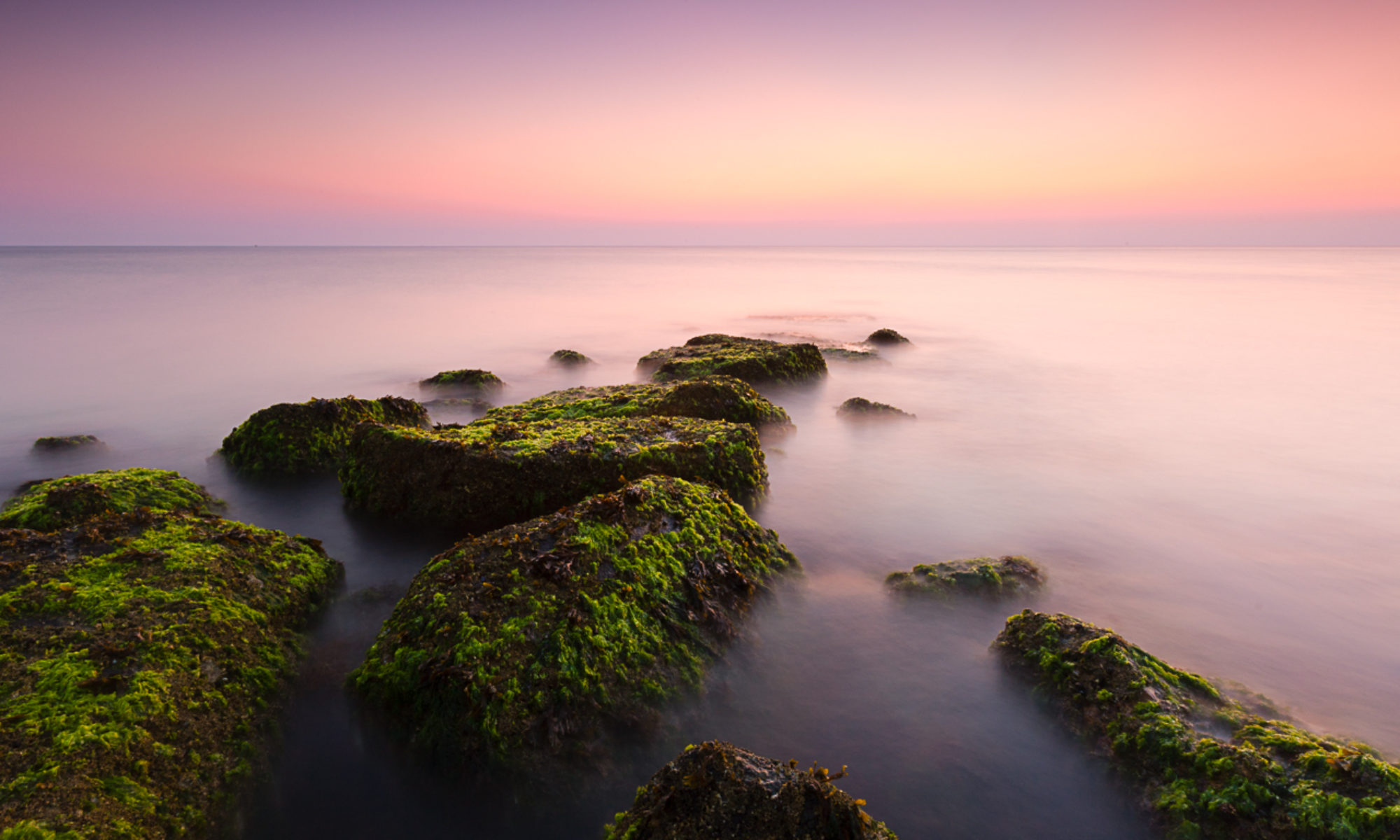
A bit more photoshop to remove some of the distracting elements to give the final image.
Nixon_130516_4876-2

Friday Inspiration: David Hall

Hall Fish

In looking to see how other people have documented the Pacific Northwest I came across the book ‘Beneath Cold Seas‘ by photographer David Hall. While this is not the kind of photography I usually gravitate towards the photographs are undeniably compelling. I particularly like the juxtaposition of what’s going on below and above the surface as in the photograph of sockeye salmon above. Photographer Hall completed this body of work over a period of 16 trips to British Columbia between 1995 and 2010. I can only imagine how technically challenging this type of photography must be, managing both scuba gear and bulky camera equipment that’s made even bulkier by the underwater housings that you need to protect them. Then of course the water’s cold.

What is striking to me is how colorful much of the marine life is. Something I thought that you had to go to the tropics to see. To see more of David’s work visit his website – www.seaphotos.com and watch the gallery of his images below.

Look Behind You!

Nixon_130517_5332Look behind you is of course part of the standard audience participation in pantomime, a particularly English form of entertainment. It is also good advice to photographers because often good things are happening all around us and taking a moment to look up, down and all around can result in you spotting other good opportunities.

That was certainly the case for the photograph above. I was on the way to the Sol Duc falls and had stopped to photograph the mossy rocks that are part way to the falls. In taking a moment to look behind me I noticed that there was interesting light in the trees behind me. I shifted my attention to the trees for a little while and was fortunate enough to get a shot that, with the application of my standard B&W preset, resulted in the image at the top of the page.

So far I like this more than my mossy rock pictures and it just goes to show that looking behind you can pay off if you make a habit of it.

Friday Inspiration: Mary Randlett

Randlett

When I was poking around on Bainbridge Island recently I did a quick tour of most of the interesting shops on the main drag, Winslow street. I wasn’t looking to buy anything, my bags were perilously close to the 50lb limit imposed by the airline as it was, but rather looking. Looking for inspiration, looking for things that I could use later. In Bainbridge Arts & Crafts I came across a book by Mary Randlett called Landscapes that I thought was amazing.

Mary’s photography came to the notice of the public as the person who took the last photographs of the noted poet Theodore Roethke. She then went on to photograph Roethke’s students and other Northwest artists (including one of Johsel Namkung who I’ve written about previously), their artwork and architecture. As I understand it (from one of the essays in the Landscapes book) Mary’s landscape work was ‘personal work’, photographs that she made for herself and shared with friends as christmas cards. These photographs eventually were published in the Landscapes book.

What particularly appeals to me about Mary’s work is that there is little of the grand landscape here. The feeling is much more of someone who had spent time with the landscape, enough time to let the landscape reveal itself.

To see more of Mary Randlett’s Landscape work I highly recommend the Landscapes book. The University of Washington has some of her work online in their digital collection. As always let me know if you find a good resource that I missed.

Randlett_Beach

Shooting in the Rain

Nixon_130518_6497

People always tell me that interesting photographs are made when there’s interesting weather. I’m not sure that rain falls into the ‘interesting’ category but we’ve certainly had a lot of the stuff in the last couple of weeks regardless of which coast you’re on. Going to a location to photograph and getting rain the whole time you’re there leaves you with some choices but essentially, wait for the rain to stop or get out in the stuff and make the most of it.

I’ve definitely been one to wait for the rain to stop, particularly when it’s cold. Who needs to be wet and cold? For shooting in forests in the spring, overcast weather, perhaps a little drizzly, is ideal. But that also means you have to deal with how to prevent your gear from getting too wet. Part of my reluctance to photographing in the rain is that, since electronics and water do not mix, it just doesn’t make sense. Now I know that many DSLR cameras have some degree of ‘weather-proofing’, and generally the higher up in the range the better the weather proofing but nothing is ideal. Art Wolfe tells an amusing story of how he encouraged a group of his workshop students using Canon 5Dmkii cameras to keep shooting even though it was raining and all their cameras stopped working while his 1D kept going.

So you’re committed to shooting in all weathers what to do? You could of course use an umbrella like the photographer in the image above. The classic approach that many workshop instructors will advise is to use a hand towel placed on top of your gear. It absorbs the rain and you can wipe your stuff down too. It seems to work quite well and hand towels are readily available, especially if you’re staying in a hotel! You could perhaps compliment this with one of the disposable shower caps that you can often find in hotel rooms which would cover up the back of the camera.

An alternate to this approach is the use of rain covers. There are an number of such proprietary covers that fit every budget. I have an aquatech basic cover, shown below. The one odd thing about this rain cover is that it also requires a special eyepiece that’s specific for your camera. The eyepiece is neat, large and spongy, perfect for someone like me who wears glasses and so I keep it on the camera full time. It’s a bit of a wrestle to get the cover on but it works great.

2013-05-24 13.50.55

My friend Jen showed me how to improvise a serviceable rain cover from a couple of items you can find in the produce isle of the local grocery store. Check it out in the image below.

Nixon_130518_0304

To make this you need one of the plastic bags that grocery stores provide for loose vegetables and a sturdy rubber band. I’m told that the rubber bands that hold bundles of asparagus together are ideal, although I like the ones that hold Andy Boy brand broccoli together. Then all you need to do is put the bag over the camera with the open end towards the camera body. Use the rubber band to hold the bag in place around the lens and then once the bag is firmly in place tear out the bottom so that the lens has an unobstructed view. I know many people would advise against it but I have skylight filters on all of my lenses and so ‘tearing the bottom out of the bag’ is really a matter of running my finger nail around the groove between the filter and the lens which is generally enough to neatly tear the bag. For those old enough to remember CDs, I used to do something similar to open the CD package – run my finger along the groove that the hinge of the case between the top and bottom parts. I must admit that this improvised cover works just as well as my aquatech cover. Something to consider if your caught out.

Friday Inspiration: Pat O'Hara

NP-OM-418V

In doing research for my trip to the Olympic National Park one name that came up in a couple of places was that of Pat O’Hara. I’ve found it tough to find out about Pat. He seems to have been most active before the internet kicked into high gear and so there isn’t a big Pat O’Hara web footprint. There is some material – this page on the Nikon website gives a nice biography of Pat and gives a sense of his path to photography from his military service days in Vietnam in the 60’s escaping into photography during his R&R time to his photobooks that serve his passion for the environment and conservation. The gallery of images on this page is also a good resource giving a good overview of Pat’s work – a mix of both the grand and intimate landscape.

There is more information about Pat on the Visionary Wild website, largely because the principal there, Justin Black, seems to have coaxed Pat into teaching a workshop a year or two ago. I actually looked at this workshop which was based in the Olympic National Park with a special extension in Pat’s studio but passed on it because I had too many other commitments and thought, foolishly, that I could go to the next one. I haven’t seen another offered but would of course jump on it given the chance.

Given the relative small footprint on the web we are then left to look at Pat’s books. Fortunately many are available on amazon.com. Click here to see a list. The first of his books to arrive from amazon was ‘Olympic National Park‘ which has the perfect subtitle ‘Where the mountain meets the sea’. It’s a delightful tour through the park, especially since every image is a unique perspective that I have yet to see elsewhere, plus there is a blend as a mentioned above of grand and intimate landscapes. His work really makes me realize that there are unique images to be made in even the most well visited places if you just take the time to go beyond the postcard shot.

If you find a good source of Pat O’Hara’s work, let me know I’d love to see it.

The Path Home

Nixon_130518_6502

Home again after what seems like quite a while in the Pacific Northwest. I’m still digesting what I saw and learned while I was out there, so be prepared for Pacific Northwest related posts for at least the next week or so. Just for the record my path home was car, boat, car, plane, car. Not tortuous, but it did involve a Viking Festival, which was a surprise.